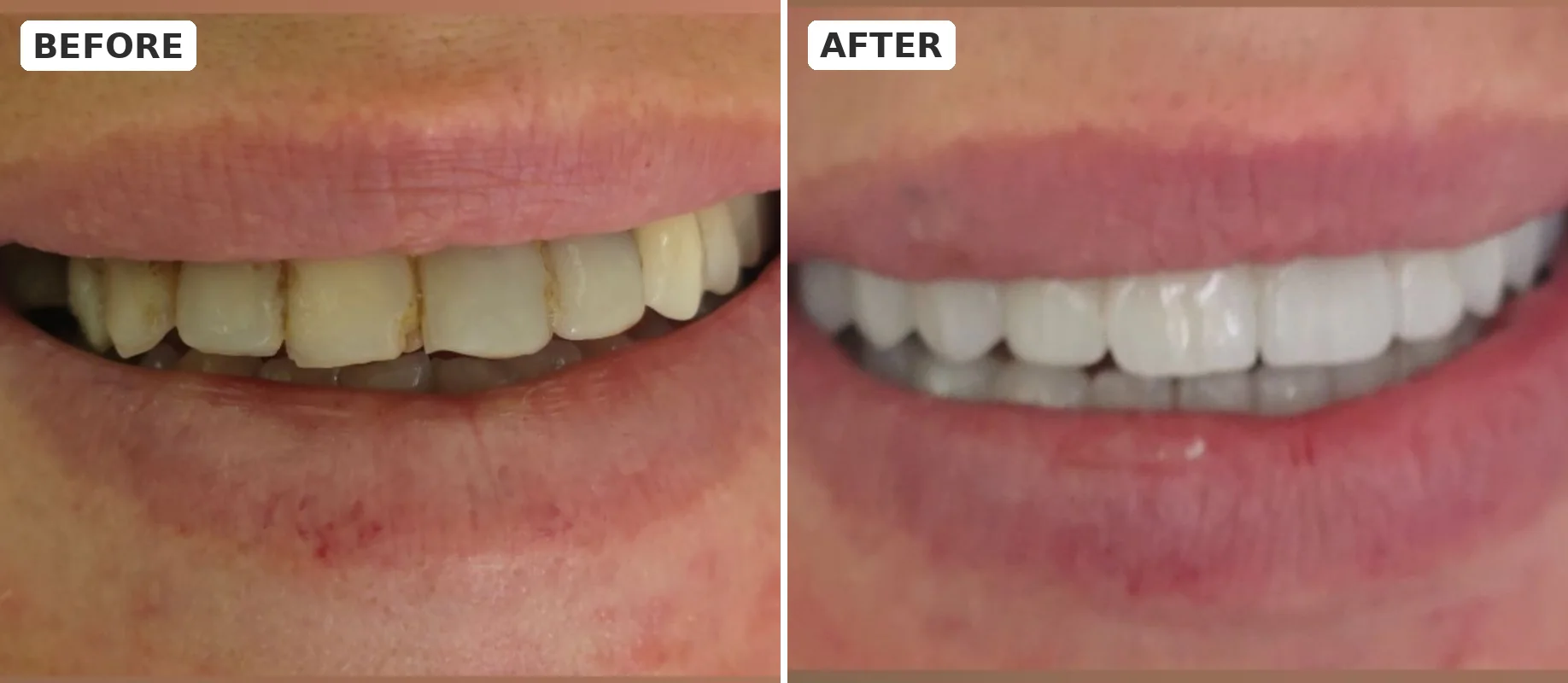
When we meet someone for the first time, one of the details we notice fastest is their smile.
We do not think about it much, but our gaze is often drawn to the teeth. Are they white? What shape and size are they? Are they straight? How do they fit into the smile? Does the smile feel open, bright and natural?
But a smile does not only tell us something about teeth. It often tells us how a person feels. Someone laughs freely, without thinking. Someone else tries to hide their smile with a hand, keeps their mouth closed in photographs or avoids smiling widely.
That is why cosmetic dentistry is not just a matter of beautiful teeth. It is also a matter of confidence, expression and the way we experience our own smile. But what actually makes a smile natural and beautiful?
White teeth do not mean an artificial smile
There is a belief that natural teeth must be slightly yellowish and that distinctly white teeth automatically look artificial. That is simply not true. Natural teeth can be very white.
What determines whether a tooth will look natural is not only its colour. Shape, size, proportions, translucency, surface texture and the way the tooth reflects light all matter.
That is why two teeth of the same shade can look completely different. One can appear flat, uniform and opaque, while the other can have depth, subtle transitions and a natural play of light. That is exactly where the difference lies.
Naturalness is not found in colour alone
A natural tooth is not a single-colour white surface. Enamel lets a certain amount of light through, and different parts of the tooth have different optical characteristics. That is why a natural tooth has depth and a certain transparency.
In cosmetic dentistry it is therefore not enough to choose a shade that is "pretty". You have to think about how the tooth will look when light falls on it, how it will blend with the neighbouring teeth and how it will appear under different lighting conditions. That is one of the reasons why top-level aesthetic work does not have to be noticeable at all.
Shape and size change the character of a smile
When we talk about aesthetics, we often focus on colour. However, the shape of the teeth can play an equally important role. The length and width of the front teeth, their relationship to each other, the shape of the corners and incisal edges all influence the character of the smile.
A small change in length can make a smile more open. A change in width can affect its fullness. A different shape can give a softer or a more defined look. That is why there is no single tooth shape that suits everyone. A smile should not be copied. It is planned individually.
A few millimetres can change a lot
With aesthetic corrections, small changes can make a big difference. If the front teeth are too short, the smile can appear less expressive. If they are too long, they can dominate too much. The same applies to the width and position of the teeth.
That is why planning is not just about how an individual tooth will look, but how all the teeth will work together as a whole. Their relationship to the lips and the way they are seen during speech and smiling also matter. The goal is not to make the teeth as big, as white or as regular as possible. The goal is to find the right measure.
A smile has to look good in motion too
A smile is not a photograph. When we talk, laugh or just slightly raise the corners of our lips, the position of the lips and the visibility of the teeth change. That is why a single photograph cannot always show how a particular aesthetic result will look in everyday life.
That is exactly why smile planning looks at several situations - the face at rest, speech and different forms of smiling. Because a smile that looks good from only one angle is not necessarily a good smile.
Why do the same teeth not look the same on everyone?
Imagine two people with exactly the same shape, size and colour of teeth. The result would still not be the same. The reason is simple: every smile is part of a particular face.
The shape of the lips, the proportions, the way a person smiles and many other individual characteristics influence the final result. That is why a photograph of a smile we like can be an inspiration, but it should not be a blueprint for our own smile.
That is exactly why at Elite Dent we approach aesthetic planning individually. As Dr Ćulum points out, a good aesthetic result does not begin with choosing a "model" of teeth, but with understanding the person and what will suit them best.
Does the whole smile always need to change?
No. And that is perhaps one of the most important things a patient should know before an aesthetic treatment.
For some, professional whitening will be enough. For others, a small shape correction or composite bonding will make a big difference. Some will need a few ceramic restorations, while for another patient orthodontic treatment will be recommended first. And sometimes the best decision is simply to leave the natural teeth as they are.
Good cosmetic dentistry is not about changing as much as possible. What matters is knowing what should be changed - and what should not be touched.
When does a smile look natural?
A natural smile does not necessarily mean an imperfect smile. It can be very white. It can be very regular. But there has to be harmony between the different elements.
Colour, shape, size, proportions, translucency and surface texture have to work together. When all of that is properly balanced, teeth can be distinctly white and still look completely natural. Naturalness is not the absence of aesthetics. Naturalness is the result of good aesthetics.
A smile that suits you
The best aesthetic result is not necessarily the one everyone will notice immediately. Sometimes it is exactly the opposite. People notice that you look more rested, fresher or more confident, but they cannot immediately say what has changed.
That is because a good aesthetic smile should not look like something "added" to the face. It should feel like a natural part of it.
At Elite Dent, the goal of aesthetic planning is not to create the same smile for every patient, but to find the combination of shape, size, colour and tooth characteristics that best suits that particular person.
Because a beautiful smile is not one that looks like someone else's. A beautiful smile is one in which you recognise yourself - just with more confidence. If you are considering an aesthetic smile correction, book a consultation - a conversation commits you to nothing, and it resolves most doubts.