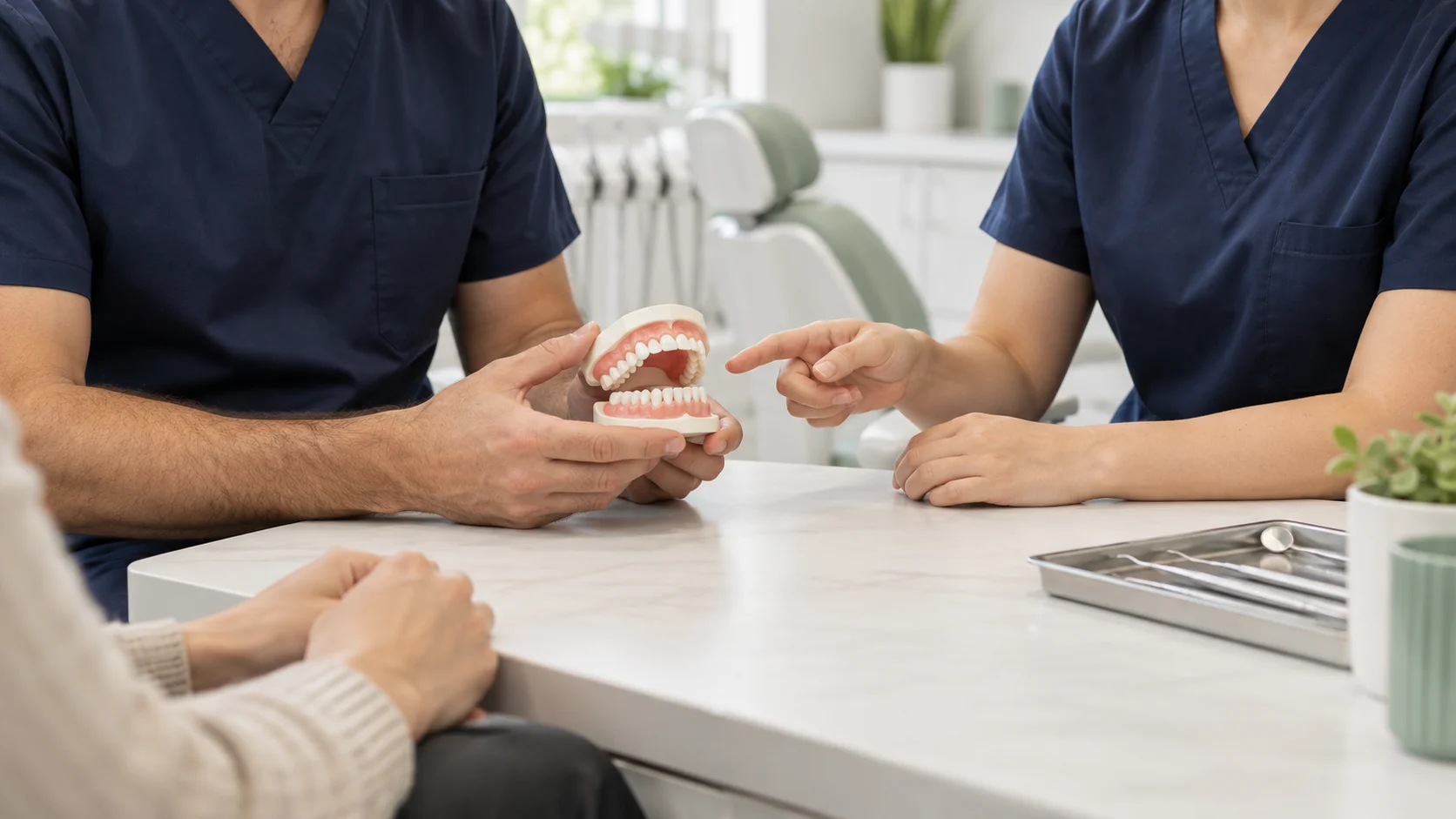
“Is the dentist a man?”
A question we sometimes hear before the patient has even met the dentist.
Then comes something even more interesting:
“Somehow, I trust a male dentist more.”
Why?
Does a man really inspire more trust?
Or is it simply a first impression shaped by society, family and our own experiences?
Perhaps the answer is not that simple.
Why does a man sometimes seem like the safer choice?
When thinking about more complex dental procedures, such as implants, surgery or extensive rehabilitation, some patients naturally look for someone who appears decisive, confident and experienced.
Men have traditionally been associated more often with authority and decisiveness, so it is not unusual for some patients to see them as a “safer pair of hands” at first glance.
But this does not mean every patient will feel that way.
For some, a female dentist will inspire more trust.
Because of her way of communicating.
Her calm manner.
The attention she pays to detail.
A previous positive experience.
And that brings us to a much more interesting question:
Do we actually trust a gender — or a person?
First impressions can be powerful.
Before the dentist has even looked at a tooth, the patient may already have formed an impression.
Based on appearance.
Voice.
The way they speak.
Age.
Gender.
Even the way they enter the practice.
Our brains use all of this to make a quick judgement:
“Am I safe?”
That is entirely human.
Especially when we are sitting in a dental chair and need to entrust someone with our health.
But first impressions and actual expertise are not always the same thing.
Men and women can be equally good dentists
A good dentist can be a man.
A good dentist can be a woman.
One may be very direct, another very calm.
One may talk a lot, another listen carefully.
One may have decades of experience, another up-to-date knowledge and a different approach.
All of these qualities can be equally valuable.
Because the quality of a dentist is not determined by gender.
It is determined by knowledge, experience, precision, responsibility, continuing professional development and the way they treat their patients.
And often by something that cannot be put in a biography:
how much they truly care about the outcome.
Trust cannot simply be commanded
You can have the best diploma on the wall and a modern practice, but if patients do not feel heard, they will find it hard to trust you.
Trust is built through conversation.
Explanation.
Honesty.
Good diagnostics.
A clear treatment plan.
And those small moments when a patient realises:
“This dentist is really listening to me.”
That is why a patient sometimes arrives with a preconceived opinion about male or female dentists and leaves the practice with a completely different one.
Because they have met a person, not a stereotype.
What are patients really looking for?
Once we set aside the assumptions, most patients want very simple things.
They want their dentist to know what they are doing.
They want the treatment explained.
They want to be able to ask questions.
They want to feel safe.
They want to know what to expect.
And they want a good result.
Some people need more time to feel this way.
Others develop trust at the very first examination.
Some value the dentist’s experience most.
Others value communication.
Others a friend’s recommendation.
And all of that is perfectly fine.
Perhaps the best moment is when we stop choosing a “male” or “female” dentist
...and start choosing our own dentist.
Someone we can openly tell what we want.
Someone we can tell what we are afraid of.
Someone we can ask ten questions if we need to.
Someone who will tell us when something is a good idea — and when it is not.
And someone we can trust to find the best solution together with us.
At Elite Dent, we believe that a good relationship between a patient and a dentist is not based on whether the dentist is a man or a woman.
It is based on trust, expertise and mutual respect.
Because ultimately, when patients leave the practice, what matters most is not who stood on the other side of the dental chair.
What matters is that they know:
“I made the right choice.”