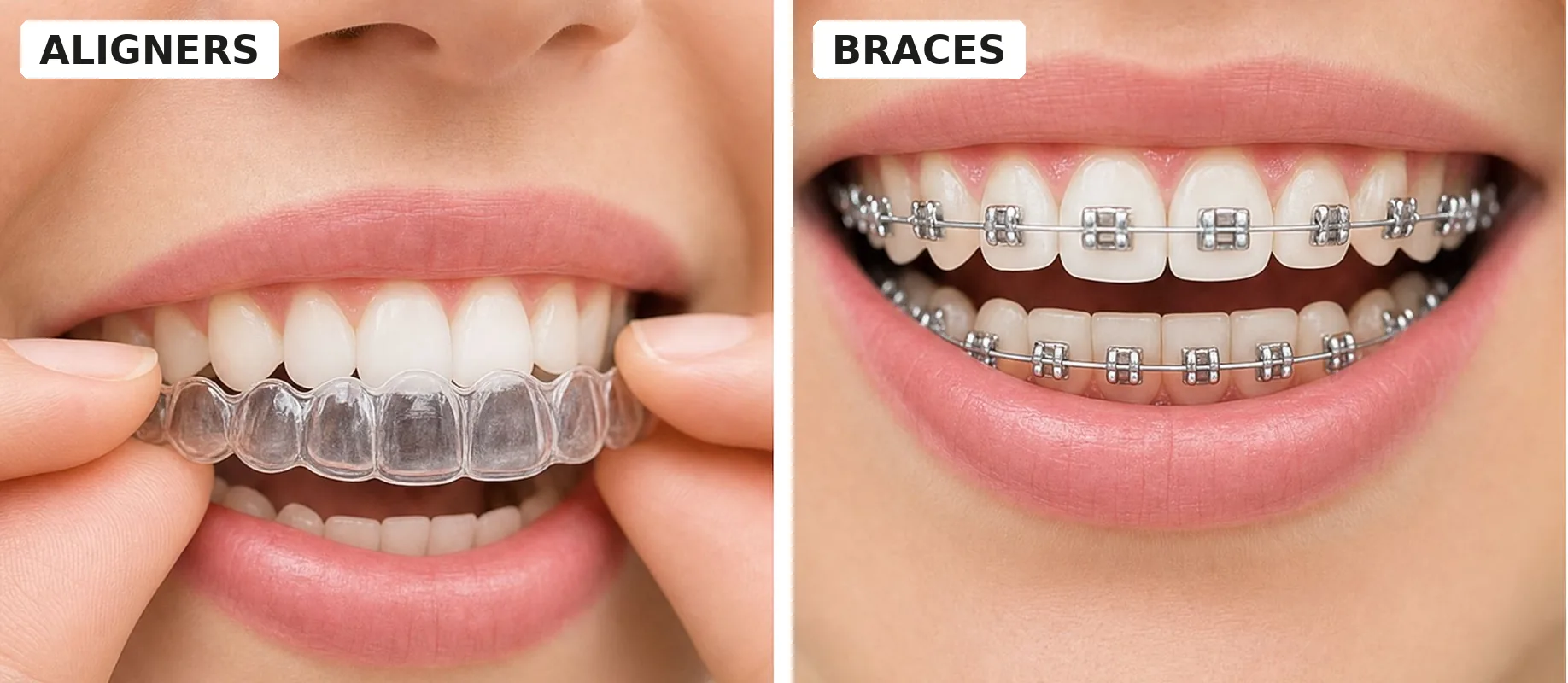
Clear aligners have become the most sought-after way to get straight teeth without metal brackets.
More and more adults want a beautiful smile but give up at the very thought of conventional braces. Today that is no longer the only route. Clear aligners move the teeth gradually and almost imperceptibly, so the people around you often have no idea you are undergoing treatment.
Aligners are not the answer in every case, though. That is why we hear the same question almost daily: clear aligners or braces? In this article we compare both methods directly - comfort, hygiene, treatment time and cost - so the decision becomes easier.
What are clear aligners
Clear aligners are thin, transparent trays custom-made for your teeth. They are worn over the teeth and gradually move them into the desired position. They are almost invisible, so most people will not notice you are wearing them.
Unlike conventional braces, aligners are removable. That means you eat and brush your teeth as usual, with no dietary restrictions. At Elite Dent we work with FullAlign aligners, a system suited to mild and moderate irregularities.
The main advantages of aligners are:
- Discretion - they are transparent and hard to spot.
- Comfort - no brackets or wires irritating the soft tissue.
- Simple hygiene - aligners come out when you brush.
- No dietary restrictions - you eat exactly as before.
- Fewer visits to the practice during treatment.
How treatment with aligners works
Treatment starts with a digital impression. Instead of uncomfortable impression materials we use an intraoral scanner, which produces a precise 3D scan of your teeth in a few minutes. The movement plan is built on that scan, often together with a digital simulation of the final result.
You then receive a series of aligners. Each is worn for about two weeks before you move on to the next one. Aligners are worn 20 to 22 hours a day and taken out only for meals and brushing. Check-ups are less frequent than with fixed braces.
What are dental braces
Dental braces are a proven method that has been in use for decades. There are two basic types.
Fixed braces consist of brackets bonded to the teeth and a wire connecting them. They stay in place throughout treatment and work continuously. Removable braces can be taken out and are used mostly with children or for milder corrections.
The greatest advantage of fixed braces is force. They resolve even very complex irregularities that aligners cannot. The downsides are that they are visible, make hygiene harder and require avoiding certain foods.
Removable braces, on the other hand, are used for milder corrections and in children whose jaws are still growing. The child takes them out for meals and brushing and wears them a set number of hours a day as instructed. They cannot replace fixed braces in serious irregularities, but they are useful in the early stage of development.
When braces are the better choice
Fixed braces still have their place. We give them preference in pronounced bite irregularities, severe crowding and in children whose jaws are still growing. In such cases they deliver a result aligners often cannot achieve on their own.
Aligners or braces: the key differences
To make the comparison clear, here is an overview of the most important differences.
| Feature | Clear aligners | Fixed braces |
|---|---|---|
| Appearance | Transparent, almost invisible | Visible brackets and wire |
| Comfort | No soft tissue irritation | Possible irritation at first |
| Hygiene | Simple, aligners are removed | More demanding around brackets |
| Diet | No restrictions | Hard and sticky food avoided |
| Discipline | Down to the patient, 20 h+ per day | Works constantly, nothing to remember |
| Ideal for | Mild and moderate cases, adults | Complex cases, children |
Which option is right for you
There is no universally better method, only the one that suits you.
Clear aligners are an excellent choice if:
- You have mild to moderate irregularities.
- You want treatment to be as unnoticeable as possible.
- You lead an active life and value freedom in your diet.
- You are ready to wear the aligners consistently every day.
Braces are the better choice if:
- You have a complex bite irregularity or severe crowding.
- The patient is a child or a teenager.
- You want a method that works constantly, without relying on your discipline.
The final assessment always comes after an examination. Some cases are resolved with aligners alone, some with braces alone, and some with a combination. We provide all options as part of our orthodontic care, for children and adults.
The most common misconceptions about aligners
Mistaken beliefs about aligners still circulate and put patients off treatment. Clear aligners have become a sought-after service, so it matters to separate fact from myth.
The first misconception is that aligners serve aesthetics only. That is not true. Correct tooth position makes hygiene easier, lowers the risk of decay and relieves the bite. Aligner treatment is a health measure, not merely a cosmetic one.
The second misconception is that aligners are only for teenagers. On the contrary, adults are the ones who most often choose aligners, because they want discreet treatment that does not affect their professional appearance.
The third misconception is that aligners work more slowly than braces. In suitable cases aligners deliver a result just as quickly, provided they are worn consistently.
Why a retainer is mandatory after treatment
Whichever method you choose, treatment does not end when the aligners or braces come off. Teeth have a natural tendency to drift back towards their original position. This is where the retainer comes in.
A dental retainer is a thin wire or a clear tray that holds the teeth in their new position. A fixed retainer is bonded to the inner surface of the teeth and stays invisible. A removable retainer is usually worn at night. Without a retainer, months of invested effort can be lost. That is why we consider it a mandatory step of treatment, not an optional one.
Conclusion
Straight teeth are the result of a plan, not of chance. At Elite Dent you are seen by Dr Boris Ćulum, founder of the practice, with more than 15 years of experience, backed by a practice with over 20 years behind it. We approach every patient individually, because the same movement does not suit everyone.
Before treatment begins we explain in detail what is realistically achievable, how long it will take and how it will progress. Thanks to digital planning, you see the result before you put in the first aligner. Once the teeth are in the ideal position, the smile can be refined further with cosmetic dentistry services such as whitening.
What patients value most is the absence of pressure. We do not push the more expensive method when a simpler one delivers the same result. Our job is to present all the options and state the advantages and drawbacks of each clearly - the decision is yours. With regular check-ups we track every movement and adjust the plan when needed, so the final smile is exactly the one you had in mind.
Frequently asked questions about clear aligners
Do clear aligners hurt?
No. A mild feeling of pressure is possible in the first few days after switching to a new aligner, because the teeth are beginning to move. That sensation passes quickly and is a sign the treatment is working.
How long does treatment with aligners take?
It depends on the complexity of the case. Milder corrections take from a few months, while more demanding cases can take a year or longer. You get the exact time frame at your examination.
Can aligners correct absolutely every irregularity?
Not all of them. Aligners handle mild and moderate cases very well. In very complex irregularities fixed braces deliver the better result.
How many hours a day are aligners worn?
20 to 22 hours a day is recommended. They are taken out only for meals and brushing. The result depends directly on consistent wear.
Is a retainer worn for life?
For the result to last, a retainer is used long term. A fixed retainer can stay in place for years, while a removable one is usually worn at night. We determine the exact regimen according to your case.
How much does treatment cost?
The price depends on the method and the duration. You can find indicative figures in our pricelist, and you receive a precise quote after the examination. Book an examination and find out which option is right for your smile.